
The ICC Men’s T20 World Cup 2026 delivered many thrilling moments, but one story stood out beyond boundaries and wickets. It was the story of Aamir Kaleem, Oman’s experienced all-rounder, who became the oldest player ever to feature in T20 World Cup history.
At 44 years and 81 days, Kaleem etched his name into cricket’s record books, surpassing the previous milestone set by Ryan Campbell. In a format widely known for youth, speed, and explosive athleticism, Kaleem’s achievement is nothing short of remarkable.
But who exactly is Aamir Kaleem? How did he rise to become a pillar of Omani cricket? And what does his record mean for the future of Associate nation cricket? Let’s explore his journey in detail.
Image Source: ICC official website
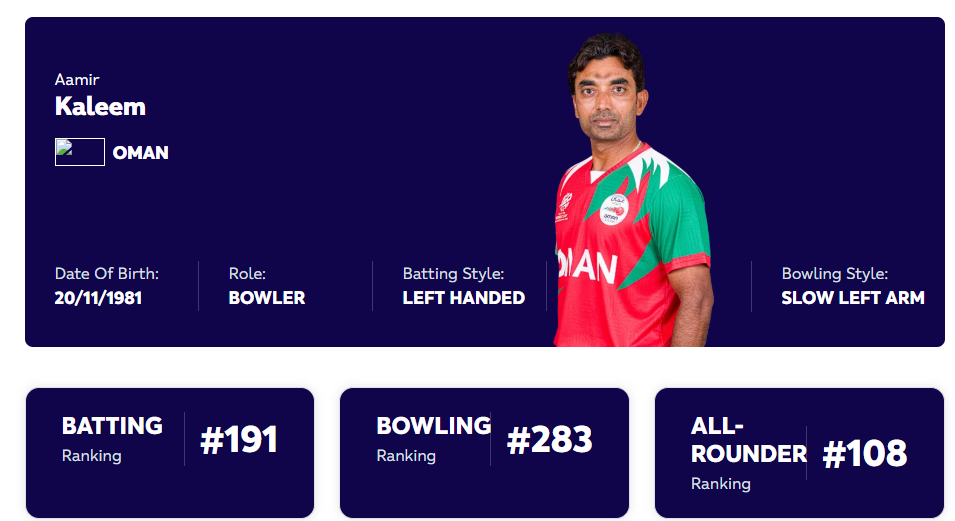
Table of Contents
A Historic Moment at the ICC Men’s T20 World Cup 2026
ICC Men’s T20 World Cup 2026
Oman national cricket team
Zimbabwe national cricket team
On 9 February 2026, when Oman faced Zimbabwe at the Sinhalese Sports Club, history quietly unfolded. As Aamir Kaleem walked onto the field, he officially became the oldest player ever to play in a T20 World Cup match.
This was not a ceremonial appearance. Kaleem was in the playing XI based on merit. His selection reflected both his consistent performance and the faith the team management placed in his experience.
In a tournament packed with young talents, his presence reminded fans that cricket still values endurance, skill, and maturity.
Breaking a Decade-Old Record
Ryan Campbell
Hong Kong national cricket team
Before Kaleem, the record belonged to Ryan Campbell, who represented Hong Kong at the 2016 T20 World Cup at the age of 44 years and 34 days. That milestone stood for nearly a decade.
Here’s how the list of the oldest T20 World Cup players now looks:
- Aamir Kaleem (Oman) – 44 years, 81 days (2026)
- Ryan Campbell (Hong Kong) – 44 years, 34 days (2016)
- Frank Nsubuga (Uganda) – 43 years, 285 days (2024)
- Brad Hogg (Australia) – 43 years, 45 days (2014)
Frank Nsubuga
Brad Hogg
This is elite company. All these names represent resilience and longevity. But Kaleem now sits at the top.
Who Is Aamir Kaleem?
Aamir Kaleem was born in Karachi, Pakistan, in 1981. Like many talented cricketers from the region, he grew up in a competitive cricketing environment.
However, his journey took a different path. In 2010, he moved to Oman to pursue professional opportunities and continued playing cricket. What began as a relocation for better prospects eventually turned into a full-fledged international career with the Oman national team.
Today, Kaleem is regarded as one of the most important figures in Omani cricket history.
From Karachi to Muscat: The Early Years
Karachi
Muscat
Growing up in Karachi, Kaleem was surrounded by cricket culture. The city has produced countless talented players. However, breaking into Pakistan’s highly competitive system is never easy.
When Kaleem shifted to Muscat, he found a new opportunity. Oman’s cricketing structure was growing, and Associate nations were beginning to receive more global exposure.
Instead of fading away, Kaleem reinvented himself.
He worked consistently on his fitness, refined his skills, and slowly cemented his place in Oman’s squad.
A True All-Rounder: Batting and Bowling Strengths
What makes Aamir Kaleem special is his dual impact.
He is:
- A left-handed batter
- A slow left-arm orthodox bowler
As a batter, Kaleem brings stability at the top or middle order. He can anchor an innings when needed or accelerate during powerplay overs.
As a bowler, his variations and control make him effective in the shortest format. T20 cricket is unforgiving for bowlers, yet Kaleem has consistently delivered economical spells.
His all-round abilities provide balance to the Oman team, especially in high-pressure tournaments like the T20 World Cup.
Oman’s Rise in International Cricket
International Cricket Council
Oman’s cricket journey is inspiring. Once competing in lower divisions of the World Cricket League, the team steadily climbed the ladder.
Kaleem has been part of this transformation.
He represented Oman in:
- T20 World Cup 2016
- T20 World Cup 2021
- T20 World Cup 2026
Three appearances across a decade show consistency not only in performance but also in physical conditioning.
Associate nations often struggle with resources and exposure. Players juggle careers and cricket. Despite these challenges, Kaleem maintained international standards well into his 40s.
A Match-Winning Knock Before the Tournament
Age did not slow him down.
Just before the 2026 tournament, Kaleem smashed a stunning 80 off 47 balls in a warm-up match against Sri Lanka A. It was a powerful reminder that he was not selected for sentimental reasons.
He was selected because he could still perform.
His innings combined smart shot selection, fitness between the wickets, and calculated aggression.
For younger players in the squad, that knock was proof that experience can still dominate modern T20 cricket.
T20 Cricket: A Young Man’s Game?
T20 is often labeled as a format for explosive, athletic youngsters. Quick reflexes, fast running, and high strike rates define the format.
Yet players like Brad Hogg and now Aamir Kaleem have shown that game awareness, temperament, and tactical intelligence can be equally powerful.
At 44, maintaining fitness levels required for international cricket is extraordinary. It demands:
- Strict diet discipline
- Consistent strength training
- Recovery management
- Mental resilience
Kaleem’s achievement challenges the stereotype that elite T20 cricket has an age limit.
The 20-Team Format and Its Significance
The expanded 20-team structure of the 2026 T20 World Cup gave Associate nations greater representation.
For players like Kaleem, this format means:
- More global exposure
- Stronger competition
- Higher performance benchmarks
His record is not just personal. It highlights how Associate cricket is maturing.
Oman is no longer a peripheral team. It competes with established cricketing nations and demands respect.
The Road Ahead for Oman
Sri Lanka national cricket team
Ireland cricket team
Australia national cricket team
The challenge for Oman in 2026 is immense. To reach the Super Eight stage, they must overcome established sides like Sri Lanka, Ireland, and Australia.
It is a tough group. But Oman has improved significantly over the years.
For Kaleem, every match is an opportunity to contribute not just with runs or wickets, but with mentorship and calm leadership.
Leadership Beyond Statistics
Even if Kaleem does not score heavily in every match, his value goes beyond numbers.
Veteran players bring:
- Dressing room stability
- Strategic clarity
- Experience under pressure
- Emotional balance
In high-stakes tournaments, composure can decide outcomes.
For younger teammates, having someone who has played multiple World Cups provides psychological strength.
Longevity in Modern Cricket: What It Really Takes
Staying relevant at 44 in professional cricket is rare. It demands a mindset shift.
Kaleem likely adapted his training routines over time. Recovery becomes more important than intense workloads. Smart preparation replaces raw intensity.
He also adjusted his game. Instead of relying purely on power, he uses timing, placement, and bowling intelligence.
This evolution is what separates short careers from lasting ones.
What Aamir Kaleem’s Record Means for Associate Cricket
This milestone is not just about age.
It signals that Associate nations can produce:
- Long-serving professionals
- Tournament-impact players
- Role models for the next generation
Kaleem’s story may inspire many cricketers in emerging cricket nations who think their international dreams have an expiry date.
It proves that performance matters more than birth certificate numbers.
A Symbol of Dedication and Passion
Many athletes retire in their late 30s. Very few compete at global tournaments past 40.
Kaleem’s presence at the T20 World Cup 2026 is a celebration of discipline. It reflects years of unseen training sessions, fitness routines, and self-belief.
He is not simply the “oldest player.” He is a symbol of commitment to the game.
Conclusion
Aamir Kaleem’s journey from Karachi to becoming the oldest player in T20 World Cup history is inspiring on multiple levels. At 44 years and 81 days, he broke a long-standing record and demonstrated that elite performance is not confined to youth. His role in Oman’s rise, his all-round abilities, and his consistency across three T20 World Cups define a career built on perseverance and adaptability.
In a format dominated by speed and power, Kaleem reminds us that experience, discipline, and mental strength still matter deeply. Regardless of how Oman performs in the remainder of the ICC Men’s T20 World Cup 2026, his place in cricket history is secure. And for aspiring cricketers around the world, his story sends a powerful message: age is just a number when passion meets preparation.
Also read:- T20 World Cup 2026: Australia Announce Final Squad as Pat Cummins Gets Ruled Out